Canada’s introduction of category-based selection represents a foundational evolution of Express Entry from a purely points-based ranking engine to a hybrid model that blends quantitative scoring with strategic labour and language priorities. It responds to real economic needs while adding layers of policy nuance and complexity. For prospective immigrants, understanding this shift is critical, eligibility strategies must now consider both CRS optimization and targeted category fit.

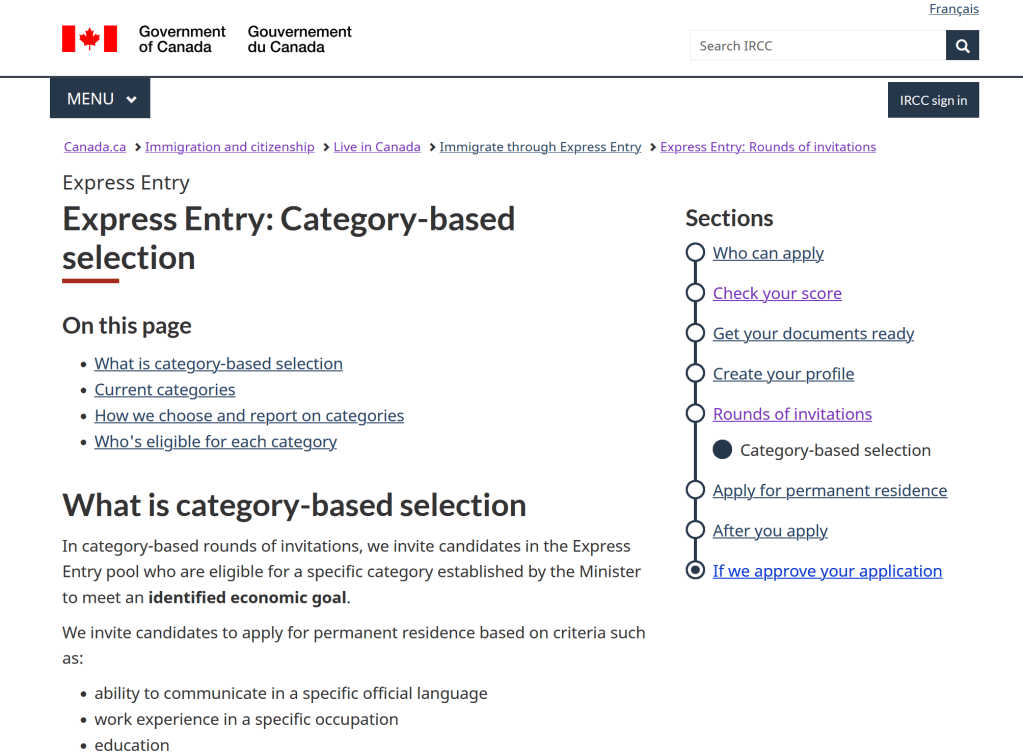
As of 2026, the official list of categories has expanded beyond earlier versions to mix both occupational groupings and experience-based profiles. These categories include:
- French-language proficiency: prioritizing candidates with high official-language ability.
- Healthcare and social services occupations: experienced Canadian and foreign health professionals.
- Science, Technology, Engineering and Mathematics (STEM) occupations: technical and scientific practitioners.
- Trade occupations: skilled tradespersons with industry experience.
- Education occupations: teachers and related professionals.
- Transport occupations: drivers, pilots and related roles.
- Physicians with Canadian work experience: specialized medical professionals.
- Senior managers with Canadian work experience: leadership-level executives.
- Researchers with Canadian work experience: academic and technical researchers.
- Skilled military recruits: Canadian Armed Forces personnel with required skills.
This expanded roster signals a shift from broad economic groupings toward targeted professions, particularly those with immediate labour-market impact.
By isolating categories such as healthcare, STEM and transport, the system responds to identified shortages in sectors where Canada struggles to recruit domestically. These targeted categories potentially lower the effective CRS threshold for candidates with category-specific strength, enabling them to be invited even if their overall CRS rank would not compete in general draws.
This is particularly visible in recent rounds: for example, Canada’s first category-based physician draw featured a record-low CRS cut-off — demonstrating that occupation-specific draws can operate with significantly different scoring dynamics than general draws.
On February 19, 2026, Immigration, Refugees and Citizenship Canada (IRCC) held its first-ever Express Entry draw specifically for physicians with Canadian work experience, featuring a record-low Comprehensive Ranking System (CRS) cut-off score of 169. This round (#397) is considered the second-lowest in Express Entry history.
Key Takeaways
1. Separation of Category Eligibility From CRS Advantage
Earlier Express Entry was a race where the highest CRS always won. Under the new system, fit for economic category matters as much as score. This is a qualitative shift, introducing “filters” that can privilege specific skills even at moderate CRS levels.
2. Increased Volatility but Greater Focus
Targeted rounds may see sharply variable CRS cut-offs reflecting demand volatility in specific sectors (e.g., healthcare spike draws versus relative silence in others). This creates opportunities for niche candidates but also uncertainty for those whose profiles do not align with current categories.
3. Policy Interdependence
The categories reflect interlocking policy aims, from managing population pressures and social services capacity to fiscal planning and labour market trends. Canada is now using Express Entry not just as an entry point but as a policy instrument for shaping workforce composition and demographic outcomes.
4. Dynamic Adjustments Year to Year
Categories are reviewed annually, which means they are not static entitlements but conditional priorities. Sectors prioritized today may be de-emphasized tomorrow, depending on labour demand and government strategy.
Looking back at Key Policy Changes (2024–2026)
Removal of Job Offer Points: As of March 2025, candidates no longer receive extra Comprehensive Ranking System (CRS) points for an LMIA-supported job offer.
Reduced PR Targets: Permanent resident (PR) targets are dropping from 485,000 in 2024 to 395,000 in 2025 and 380,000 in 2026, with an emphasis on transitioning in-Canada temporary residents.
International Student Cap: A two-year cap on study permits was introduced, with a further 10% reduction in 2025 compared to 2024. Master's and PhD students now require a Provincial Attestation Letter (PAL).
Post-Graduation Work Permit (PGWP) Reform: Eligibility is now stricter, requiring language proficiency (CLB 7 for university, CLB 5 for college) and alignment with fields of study in long-term shortages.
Spousal Work Permit Restrictions: Open work permits for spouses of international students are now restricted to master's (16+ months) or doctoral programs. Spouses of foreign workers are limited to those in "critical" sectors.
TFWP & LMIA Changes: Low-wage stream caps reduced to 10% for most sectors, and Labour Market Impact Assessment (LMIA) validity reduced to 6 months.
Express Entry Shift: Focus has shifted heavily to category-based draws targeting healthcare, STEM, trades, and French-language proficiency, with 2025 prioritizing candidates with Canadian experience.
End of "Flagpoling": Restrictions have tightened on applying for work permits at the border (flagpoling), requiring more to apply online.