Ontario’s most recent Provincial Nominee Program draw on March 18, 2026, marks a cautious but revealing shift in immigration strategy. After more than a year of silence, the province issued 582 invitations under the Masters Graduate stream and 525 under the PhD Graduate stream, totaling just over 1,100 invitations. While modest in size, the draw carries broader policy signals that extend beyond its immediate numbers.
First, the draw aligns closely with Canada’s growing emphasis on transitioning temporary residents to permanent residents. The federal government’s 2026 to 2027 targets explicitly prioritize converting individuals already in the country, with a goal of granting permanent residency to roughly 33,000 foreign workers. In this context, international graduates represent a highly strategic pool. These candidates have already spent years studying in Canada, often accumulating local credentials, social ties, and some level of labour market exposure. From a policy perspective, selecting them reduces integration risks while maximizing economic return on prior educational investment.
The design of this draw introduces an interesting tension. Historically, the Masters and PhD Graduate streams did not weigh work experience, particularly Canadian experience, in their scoring frameworks. This made them distinct from employer driven streams that prioritize immediate labour market attachment. Yet, this latest draw required candidates to have Canadian work experience in specific NOC codes, even though the scoring system itself did not strictly differentiate candidates based on the length or depth of that experience. This suggests a subtle but meaningful shift. Ontario appears to be experimenting with integrating labour market alignment into streams that were previously education focused, without fully restructuring the selection model.
The choice of eligible occupations are quite controversial. Alongside highly specialized roles such as physicists, engineers, and data scientists, the list includes positions like receptionists, couriers, legislators, and musicians. These inclusions raise questions about the coherence of the policy. If the goal is to retain advanced degree holders, the linkage between degree level and occupational eligibility appears inconsistent. It challenges the assumption that these streams are designed strictly for highly specialized talent, especially as a master’s degree has become increasingly common rather than exceptional.
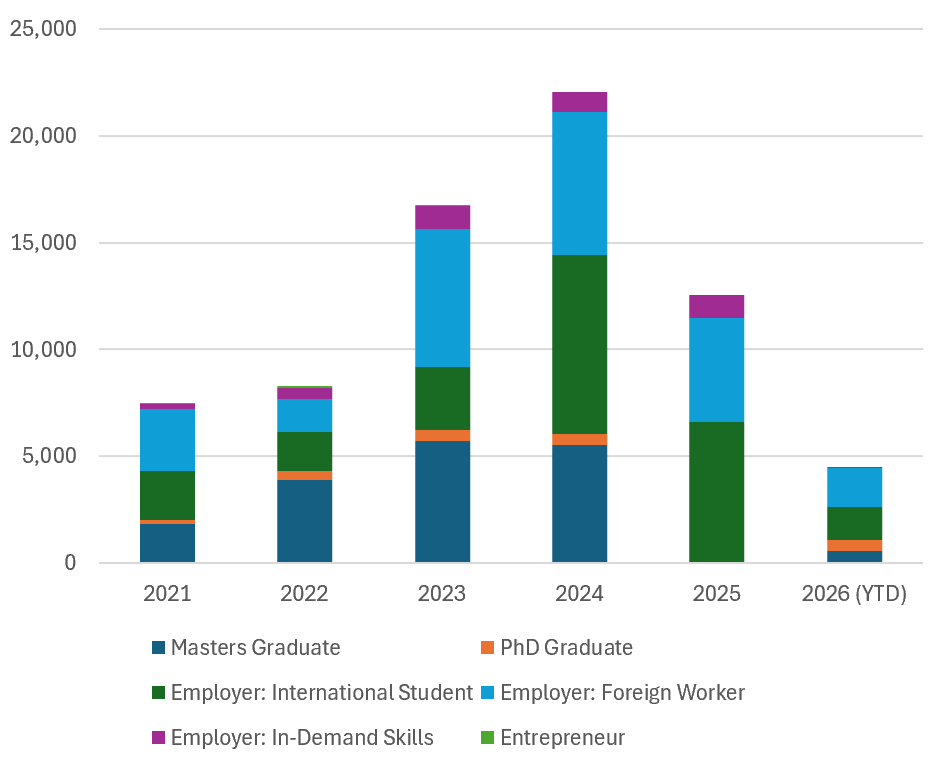
The small size of the draw reinforces the idea that this is less a full policy restart and more a limited pilot. The absence of any invitations since October 2024 had already raised concerns about transparency and system predictability. This is particularly significant for PhD candidates, who often invest four or more years in their programs with the expectation of a viable pathway to permanent residency. The sudden reactivation of the streams, without prior communication, and the unexpected requirement on Canadian work experience, does little to resolve those concerns.
The timing of this draw is also critical. With all existing OINP streams expected to be revoked in May 2026, this may be one of the last draws under the current framework. In that sense, the inclusion of Canadian work experience requirements, even in a limited form, likely signals the direction of future program design. New streams may formalize this preference more explicitly, further aligning graduate pathways with labour market outcomes. Alternatively, given the large pool of candidates (Master's stream invitations averaging 6,000 per year for 2022, 2023, and 2024), this targeted draw may have been designed to limit invitations, similar to IRCC’s refusal of PGWP applications due to missing language scores. The listed NOCs also appear less curated and more reflective of what candidates had already declared in the EOI pool, rather than a deliberate selection based on labour market needs.
Taken together, this draw reflects a system in transition. It is not a decisive overhaul, but rather a small scale test of how education based pathways can be recalibrated to meet evolving economic and political priorities.